Hydroxypropyl Methylcellulose (HPMC) has emerged as a pivotal additive in the global cleaning industry, offering unmatched versatility in stabilizing formulas and enhancing performance. Understanding hpmc uses in detergent is essential for manufacturers aiming to balance high-efficiency cleaning with consumer-friendly textures and sustainable chemistry. As the demand for specialty chemicals grows, HPMC provides the structural integrity necessary for both liquid and powder detergent systems.
On a global scale, the shift toward concentrated detergents and "green" cleaning agents has placed a premium on rheology modifiers. The integration of hpmc uses in detergent allows for the precise control of viscosity, preventing the separation of active ingredients while ensuring that the product remains easy to pour or disperse. This technical advantage directly translates to a more consistent user experience and improved product shelf-life.
Despite its benefits, the industry faces challenges regarding raw material costs and the need for biodegradable alternatives. However, HPMC remains a gold standard due to its non-toxic nature and high compatibility with other surfactants. By exploring the nuances of hpmc uses in detergent, chemists can optimize their formulations to meet strict ISO standards and evolving environmental regulations.
Global Impact of HPMC in Detergent Formulation
The global detergent market is undergoing a massive transformation, moving away from harsh chemicals toward sophisticated, cellulose-based thickeners. The widespread adoption of hpmc uses in detergent is a response to the increasing demand for "premium" cleaning products that offer a rich, gel-like consistency without sacrificing cleaning power. This trend is particularly evident in Europe and North America, where consumer preference for concentrated liquids is at an all-time high.
Industry data suggests that the use of HPMC helps manufacturers reduce the total volume of synthetic polymers needed, aligning with global sustainability goals. By optimizing the rheology of the solution, HPMC ensures that active surfactants are delivered efficiently to the fabric or surface, reducing waste and improving the overall ecological footprint of the cleaning process.
Defining HPMC and Its Role in Cleaning Chemistry
Hydroxypropyl Methylcellulose (HPMC) is a non-ionic cellulose ether derived from natural polymer cellulose. In the context of hpmc uses in detergent, it acts primarily as a thickening agent, stabilizer, and film-former. Unlike simple salts, HPMC creates a three-dimensional network in the aqueous phase, which holds other ingredients in suspension and prevents the "syneresis" or layering often seen in low-quality liquid soaps.
Beyond simple thickening, HPMC plays a crucial role in the "feel" of the product. It imparts a smooth, luxurious texture to liquid detergents and dish soaps, which consumers often associate with higher quality and effectiveness. This psychological impact is complemented by the technical ability of HPMC to remain stable across a wide range of pH levels and temperatures, making it an ideal candidate for industrial-grade cleaners.
From a humanitarian and health perspective, the non-toxic nature of HPMC makes it a safer alternative to some synthetic acrylic thickeners. As regulatory bodies like the ECHA (European Chemicals Agency) tighten restrictions on microplastics and certain polymers, the reliance on cellulose-based solutions like HPMC is expected to grow, ensuring that cleaning products are both effective and safe for human contact.
Core Technical Factors of HPMC Performance
The primary driver of hpmc uses in detergent is its ability to provide precise viscosity control. By adjusting the substitution degree of the hydroxypropyl and methyl groups, manufacturers can tailor the thickening power to suit everything from sprayable surface cleaners to thick, heavy-duty laundry gels.
Another critical factor is the thermal gelation property of HPMC. In certain high-temperature industrial cleaning applications, hpmc uses in detergent allow the product to maintain a specific viscosity profile, ensuring that the detergent doesn't become too watery when heated, which would lead to inefficient application and excessive runoff.
Lastly, the scalability of HPMC is a major advantage for large-scale chemical plants. Because it is compatible with a wide array of surfactants—including anionic, cationic, and non-ionic types—it simplifies the manufacturing process, reducing the need for complex emulsion steps and lowering the risk of batch failure during production.
Comparative Efficiency of HPMC in Various Detergents
When analyzing the performance of hpmc uses in detergent, it is important to look at how it performs across different product categories. In liquid laundry detergents, HPMC excels at suspending fragrance beads and enzyme capsules. In contrast, for dishwashing liquids, the focus shifts toward creating a clear, bubble-stable formula that doesn't separate over time.
The efficiency of HPMC is often measured by its "thickening-to-cost" ratio. Compared to traditional HEC (Hydroxyethyl Cellulose), HPMC often provides better salt tolerance and superior stability in alkaline environments, which are common in many heavy-duty degreasers and industrial cleaners.
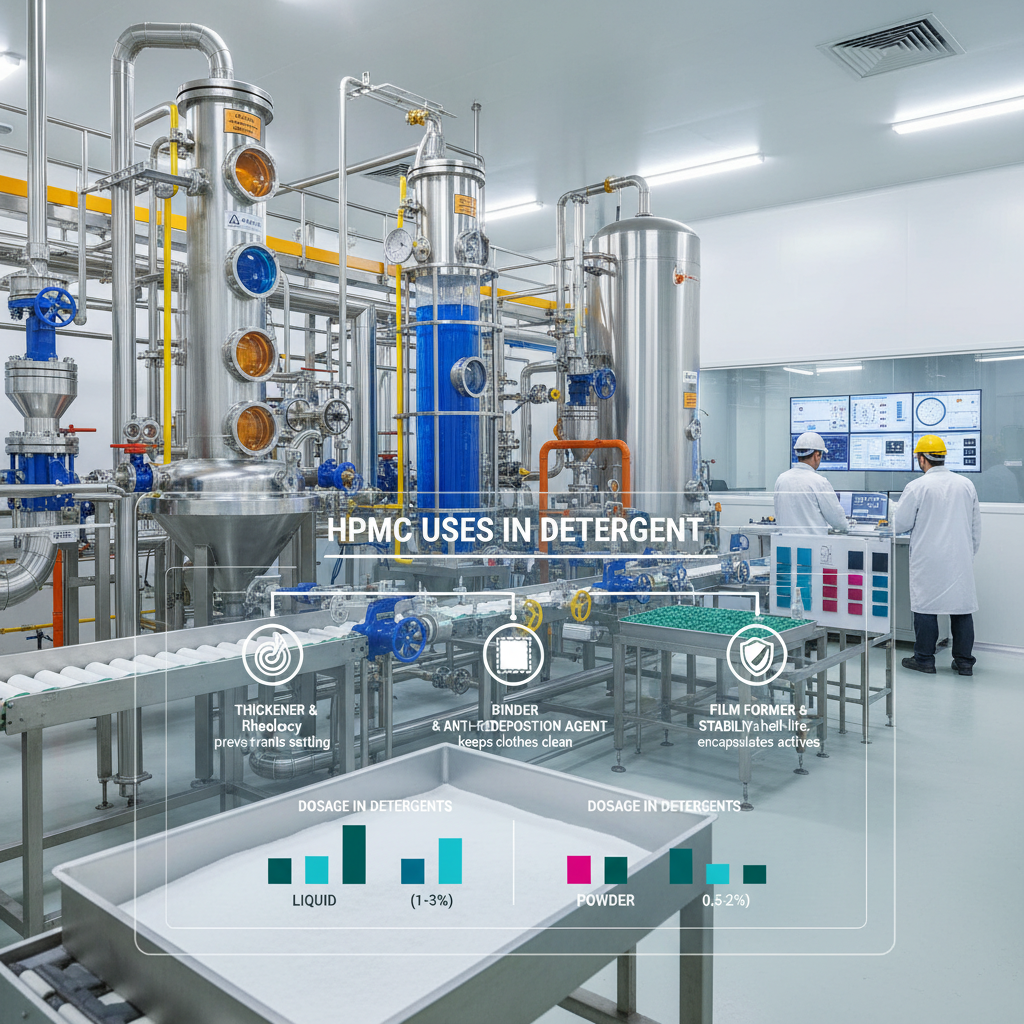
Performance Metrics of HPMC Uses in Detergent
Real-World Industrial Applications and Use Cases
In the realm of industrial cleaning, hpmc uses in detergent extend to specialized applications such as automotive degreasers and aircraft exterior cleaners. In these environments, the detergent must cling to vertical surfaces to allow the active chemicals time to break down grease and grime. HPMC provides the necessary "cling" or thixotropic property, ensuring the product doesn't simply slide off the surface.
Furthermore, in emerging markets across Southeast Asia and Africa, HPMC is being utilized to create low-cost, high-stability detergent pods. By acting as a binder in the film or the internal gel, HPMC helps maintain the integrity of the pod during transport in high-humidity regions, preventing premature leakage and ensuring that the product remains effective upon arrival at the consumer's home.
Long-Term Value and Sustainability Benefits
The transition to HPMC is not just a technical choice but a strategic move toward sustainability. Because HPMC is derived from cellulose—a renewable resource—it offers a significantly lower carbon footprint compared to petroleum-based synthetic thickeners. This shift allows brands to market their products as "bio-based," appealing to the growing demographic of eco-conscious consumers.
From an economic standpoint, hpmc uses in detergent provide long-term value by reducing product waste. Better stability means fewer expired batches and less product separation in the bottle, which reduces returns and enhances brand trust. The reliability of HPMC ensures that a bottle of detergent produced in January performs exactly the same in December.
Moreover, the safety profile of HPMC enhances the dignity and health of the workers in the manufacturing process. Unlike some volatile organic compounds (VOCs) or irritating acrylic monomers, HPMC is handled safely in powder form and dissolved easily, reducing the risk of occupational respiratory issues in chemical plants.
Future Innovations and Formulation Challenges
Looking ahead, the future of hpmc uses in detergent lies in the development of "smart" rheology. Researchers are exploring ways to modify HPMC so that it responds to specific triggers, such as a change in temperature or the presence of a specific stain, releasing active cleaning agents only when needed. This would lead to "intelligent" detergents that maximize efficiency and minimize chemical usage.
However, challenges remain, particularly regarding the dissolution speed of high-viscosity grades of HPMC. In cold-water detergents, HPMC can sometimes form "fish-eyes" (clumps of undissolved polymer). To solve this, manufacturers are adopting high-shear mixing technology and pre-dispersed HPMC granules that dissolve rapidly even in low temperatures.
Digital transformation in chemical manufacturing is also playing a role. AI-driven formulation software is now being used to predict the exact amount of HPMC required to achieve a target viscosity based on the other ingredients in the mix. This reduces the trial-and-error phase of product development, speeding up the time-to-market for new detergent lines.
Analysis of HPMC Grade Selection for Different Detergent Types
|
Detergent Category
|
Recommended HPMC Viscosity
|
Primary Function
|
Stability Score (1-10)
|
| Liquid Laundry Detergent |
Medium-High |
Suspension of Enzymes |
9 |
| Dishwashing Liquid |
Medium |
Clarity & Flow Control |
8 |
| Industrial Degreaser |
High |
Vertical Surface Cling |
7 |
| Glass Cleaner |
Low |
Anti-Streaking Agent |
9 |
| Hand Soap Gel |
Medium-High |
Texture Enhancement |
10 |
| Fabric Softener |
Medium |
Emulsion Stabilization |
8 |
FAQS
HPMC is primarily used for its superior ability to stabilize emulsions and provide a smooth, non-stringy viscosity. Unlike salt-based thickening, HPMC does not interfere with the cleaning power of surfactants and offers better stability across a wider pH range, making it more versatile for diverse detergent types.
Actually, HPMC improves the sustainability profile of detergents. Being a cellulose ether derived from natural plant sources, it is significantly more biodegradable than synthetic polyacrylates or petroleum-derived polymers, helping manufacturers meet "green" certification standards.
To avoid "fish-eyes," it is recommended to pre-disperse HPMC in a small amount of solvent or use a high-shear mixer. Alternatively, using a specially graded "easy-to-disperse" HPMC can ensure a smooth integration into the liquid phase without clumping.
Yes, HPMC is a non-ionic polymer, meaning it does not carry an electrical charge. This makes it highly compatible with anionic, cationic, and non-ionic surfactants, ensuring that the stability of the pod's internal gel is maintained without causing precipitation.
While HPMC can replace HEC in many cases, the choice depends on the desired thermal properties. HPMC has a unique thermal gelation point that can be advantageous for certain industrial cleaners, whereas HEC might be preferred for products requiring absolute clarity at very high temperatures.
Typically, HPMC is used in concentrations ranging from 0.1% to 1.5% depending on the desired viscosity. For a premium, thick gel, a concentration of 0.5% to 1.0% is usually sufficient, but this should be optimized based on the other active ingredients in the formula.
Conclusion
In summary, hpmc uses in detergent encompass a wide range of critical functions, from acting as a high-performance rheology modifier to serving as a sustainable, bio-based stabilizer. By ensuring product consistency, enhancing consumer experience through improved texture, and aligning with global environmental standards, HPMC has proven itself as an indispensable asset in modern chemical manufacturing.
As the industry moves toward smarter, greener, and more concentrated cleaning solutions, the role of cellulose ethers will only expand. Manufacturers are encouraged to optimize their HPMC grades to balance cost and performance, ensuring their products remain competitive in an increasingly demanding global market. For high-quality HPMC and expert formulation support, visit our website: www.cnjzchemical.com